

If you’re in any way involved in the world of search, then there’s no doubt you will have heard the term ‘broad core update’ or ‘Google core update’.
These system updates can significantly affect how Google evaluates and ranks websites, which is why almost every marketer dreads seeing a notification on their phone about the release of a new one. That being said, if you're doing SEO properly, there's nothing to be scared of. In fact, core updates can provide you with an opportunity to get ahead of your competitors if they're penalised for spam or search manipulation while you've been building a solid SEO strategy.
Either way, it’s important to take the time to understand what core updates are, why they happen, and the effect they can have on your website and SEO efforts.
So, if you’re not entirely clued up on broad core updates, here’s everything you need to know.
In short, a core update is when Google makes major changes to the central systems it uses to rank pages in the search results.
But why do they make changes?
Updates happen because Google’s main goal is to provide users with helpful, relevant, and reliable search results. To do this, it must continuously refine its ranking systems to better identify and prioritise webpages that offer genuinely useful and engaging content, so users always get the answers they’re searching for.
They’re known as broad core updates because they look at the overall quality and relevance of the content in the search results, rather than honing in on one specific issue. They’re not a penalty; they're simply Google’s way of keeping on top of the search results.
However, since core updates can change how Google evaluates content across the web, they can affect how a website or webpage performs in the search results, which is why they’re so important for marketers and website owners to be aware of.
Google regularly makes routine improvements to its ranking systems throughout the year, but many of these changes are small and mostly go unnoticed. When Google makes a broader, more significant change to its core ranking systems, it will typically announce it as a core update.
There is no set schedule, and the frequency of core updates can vary, but they typically release two or three throughout the year. That said, a couple of years ago, Google did state that we should expect to see core updates drop more often.
Here’s a full timeline of broad core updates:
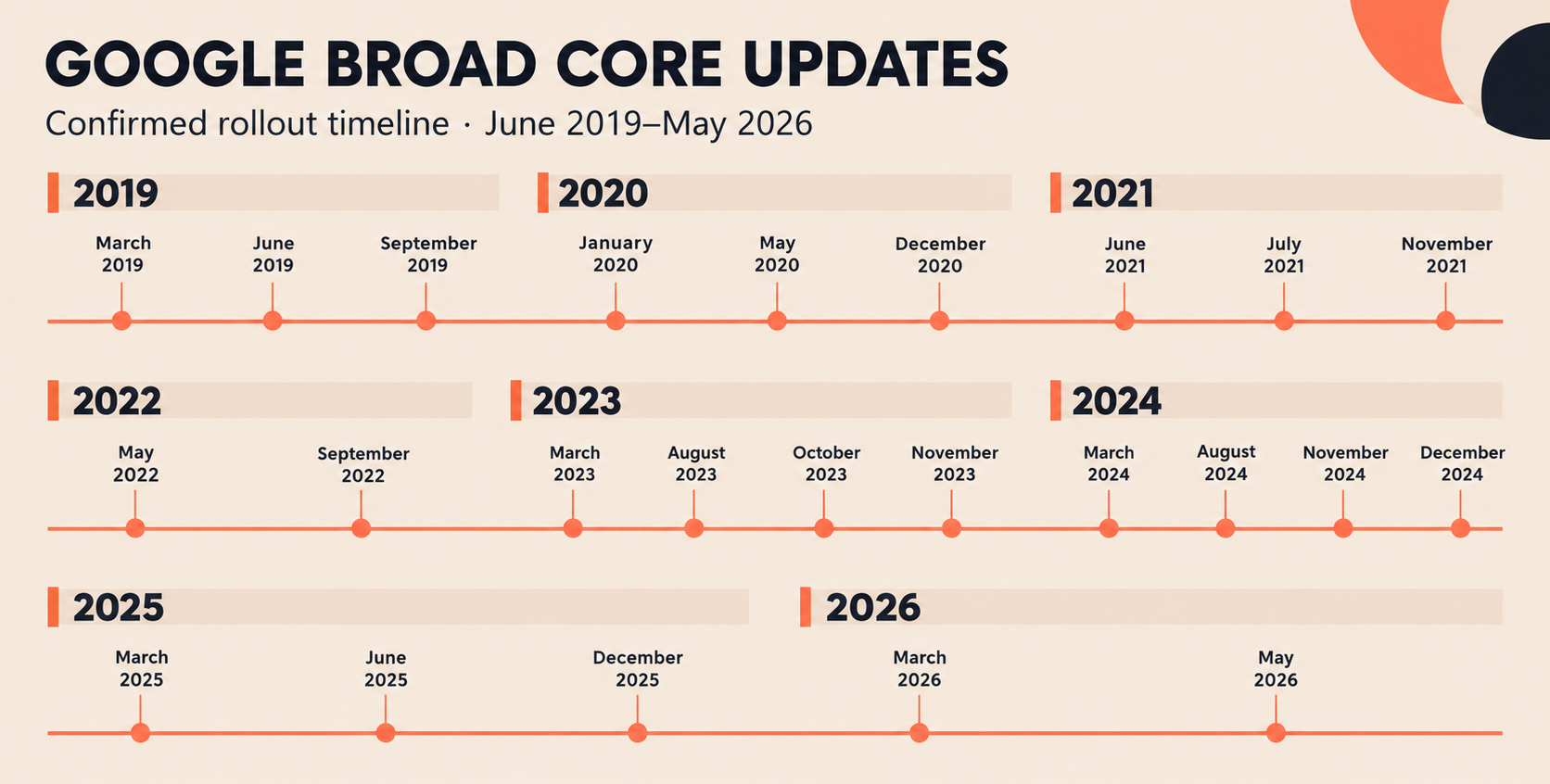
The length of an update can vary. Some only take a few days, while others can take weeks to complete. When Google announces an update, it will state the expected rollout time, but this is just an estimate, so don’t take it as gospel.
Not all core updates will have the same effect on websites. Some updates are fairly minor and may only cause some small ranking fluctuations, whilst others have the power to fundamentally change the SERPs.
During or after a rollout, you may notice:
If traffic and rankings are negatively impacted, it doesn’t necessarily mean a website has done anything wrong. Fluctuations can happen as systems reassess content across the entire web - that’s why it's important to analyse the wider search results and try to understand what’s changed rather than immediately rewriting all of the content on your site.
The term ‘broad core update’ was actually only introduced in 2018. Before this, there were several noticeable algorithm and ranking-system changes that have shaped search. Here are some of the most notable core-style updates that have had a major impact on SEO through the years.
Google Panda was introduced in 2011 to reduce the visibility of low-quality content in the search results.
This update had a huge impact on sites with large amounts of thin, low-value, or duplicate content, or sites that churned out numerous pages that only existed to attract search traffic.
Panda got website owners to focus on producing original, useful content rather than creating large volumes of content that had very little value to its readers. In 2016, Panda was incorporated into Google’s core ranking systems.
In 2012, Google Penguin was launched. This update targeted websites attempting to improve rankings through manipulative link-building tactics, including large numbers of unnatural and paid links.
This update helped Google better identify and address these practices, and like Panda, this became part of its core ranking systems in 2016.
Google wasn’t always all that great at understanding the context behind a search query, and instead relied heavily on matching individual keywords. In 2013, with Google Hummingbird, this changed.
This update helped Google interpret searches, particularly those using conversational phrases or more specific questions, and reinforced the importance of search intent as part of an SEO and content strategy.
In 2015, Google released the Mobile-Friendly Update, which became known as Mobilegeddon. This update was only aimed at mobile searches and was designed to ensure more mobile-friendly pages were showing up in smartphone results.
People anticipated that this would have a catastrophic impact, hence the Armageddon reference, but this wasn’t actually the case. For many sites, its effect was actually fairly minor. However, it did kick-start the mobile-first era of search.
The August 2018 core update was labelled the ‘Medic Update’ within the SEO industry. This was largely because it massively affected YMYL (Your Money or Your Life) websites.
YMYL content covers topics that could have an impact on someone’s health, finances, safety, or overall wellbeing. This update wasn’t officially limited to the medical sector, but many health-related websites were impacted.
This update also brought more attention to the concept of E-E-A-T, which is part of Google’s Search Quality Rater Guidelines and is used by humans to evaluate the quality of search results.
Ultimately, this update highlighted the importance of proving that content is created with care, appropriate knowledge and credibility, and is accurate and useful to readers.
The March 2024 core update was a 45-day rollout that had pretty significant developments in Google’s efforts to reduce the amount of unhelpful content in the search results. Its aim was to improve the quality of search results and reduce the visibility of content created primarily to attract traffic rather than offer value to readers.
Google initially estimated that the changes would reduce unhelpful content in the search results by 40%, but later reported a reduction of 45% in low-quality, unoriginal content.
If you’ve heard of core updates, you may have heard of spam updates too. Here are some of the key differences:
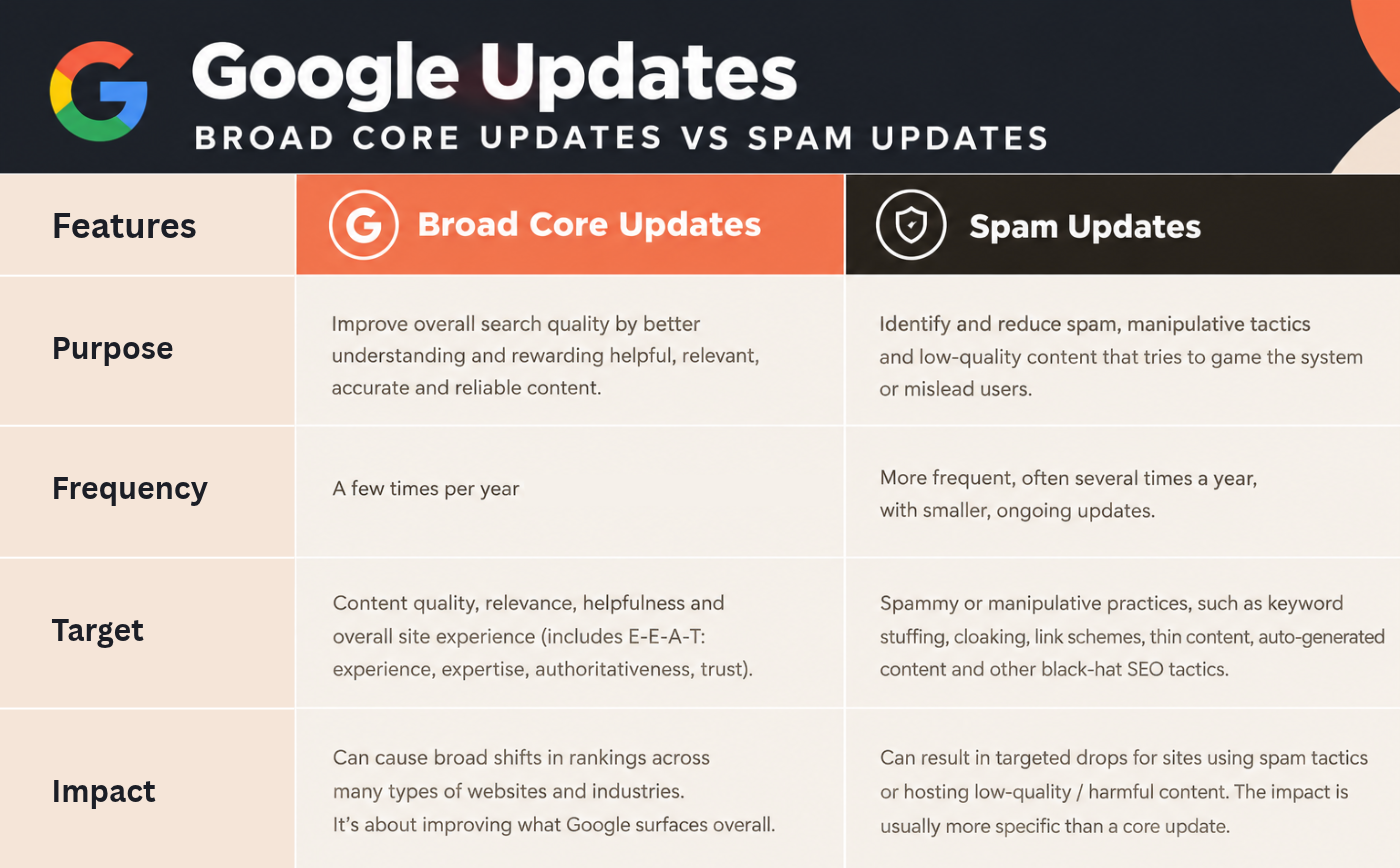
Core updates are rarely pre-announced and are usually just sprung on us. There is occasionally some speculation between SEO professionals beforehand about the possibility of an upcoming update, but this isn’t always reliable. As a result, you can’t necessarily ‘prepare’ for a core update. So instead, you need to focus on maintaining a strong website throughout the year to help ensure you come out the other side on top.
Here are some things you should be doing all the time to help you remain stable:
Creating content that genuinely helps your audience is one of the best ways to stay prepared for any upcoming core update. This means following Google’s guidelines and avoiding content written for the sake of it or just because a certain keyword has some decent search volume.
Running a content audit every so often can help you identify pages that are outdated, inaccurate, or no longer helpful for your target audience. You should carefully consider which pieces of content to refresh and which to bin, and ensure any changes you make are motivated by offering more value to the reader.
Especially if you write about YMYL topics, you need to make sure your content is trustworthy and clearly demonstrates the author is qualified and experienced enough to be discussing the topic. The best way to do this is by following the core principles of E-E-A-T.
E-E-A-T isn’t a ranking factor in itself, but it is used to assess the quality of your content, which is a ranking factor, so it is incredibly important.
Technical SEO is essential to ensure Google can crawl and index the pages you want to rank well. This includes focusing on things like:
A technically sound website means Google can access your content and people can easily browse your website.
Google announces the rollout of core updates on its Google Search Central accounts on X and LinkedIn, and updates its Google Search Status Dashboard. This is where you will find any official guidance (though there usually isn’t anything specific). We would stick to these sources above all else, as they are much more reliable than social media speculation.
Although there is no guaranteed fix or set timeframe for recovery, it is possible to recover if you’re negatively impacted by a core update.
Here’s a very brief, step-by-step recovery guide:
Oftentimes, you will only see improvements after another update, when Google has reassessed your content, but recovery can happen at any time.
It is important to note that not all ranking losses can be reversed, and not every site will recover. But with the right approach, there is a decent chance you will recover.
The bottom line is core updates can be incredibly impactful, so it’s important to keep an eye on industry news, consistently create high-quality content that is genuinely helpful to your audience, and build trust, credibility, and authority in your niche to reduce your chances of being hit by an update.
If you are hit by an update or you’ve been hit in the past and are struggling to recover, we can help. Get in touch with us today to see what we can do for you.


