
July 26, 2026

On 17 August, Google Ads will automatically rollout a Smart Bidding update. So, if you’re not paying attention, it may catch you off guard. Since this update could have a noticeable impact on campaign efficiency, it’s important to know what this update is and what you need to do about it.
The good news is that not every Google Ads account will be affected. However, if you are running campaigns using Target CPA or Target ROAS, it’s worth understanding what’s changing before this update lands.
Google has always been fairly flexible when it comes to campaigns with a limited budget. If your budget restricts how often your ads can enter auctions, Google puts more focus on the best opportunities. Advertisers have gotten very used to this process and its results, with campaigns often outperforming their Target CPA (cost per acquisition) or Target ROAS (return on ad spend) because of this additional filter.
However, from 17 August, Google is changing that.
Rather than bidding on the highest-quality opportunities, Smart Bidding will now optimise much closer towards your actual Target CPA or Target ROAS. Google has stated that they are hoping this will make bidding behaviour more predictable and ensure targets are more reflective of business objectives.
This update will mainly apply to campaigns that:
Any Search, Shopping, Performance Max, and Demand Gen campaigns using these bidding strategies could be impacted.
Campaigns using Maximise Conversions or Maximise Conversion Value without target settings aren’t included in this update.
If your campaign is already performing pretty close to your targets, then you might not notice much difference. However, if your performance is miles ahead of the targets you set in Google Ads, you may notice a significant difference.
This includes:
This may make you feel like your performance has dropped all of a sudden. However, in reality, your campaign will just be behaving in the way Google intends it to.
Example:
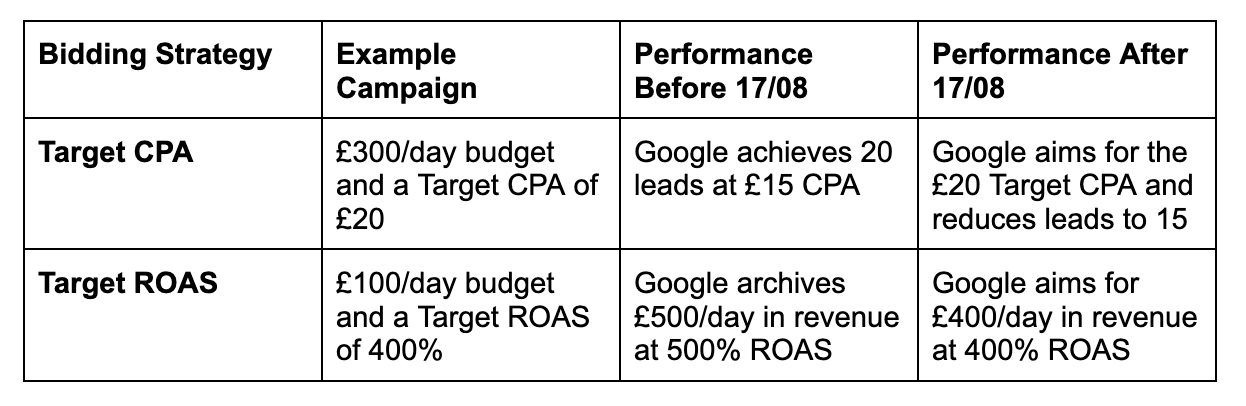
This update is unmasking a common problem (that many advertisers weren’t even aware they had) for businesses that set a Target CPA or Target ROAS years ago and never changed it.
Over time, campaigns and conversion rates improve but targets stay the same and until now, Google’s bidding system was hiding this issue. If a campaign was limited by its budget and couldn’t spend more money, it still performed better than the old target.
However, now Google is altering how its bidding works, those old targets are much more important. If they’re no longer realistic, they could stop campaigns from growing or performing well.
The businesses that will notice this update the most are probably the ones whose campaigns have been doing incredibly well, despite relying on outdated bidding targets.
What you definitely shouldn’t do is wait until after the update rolls out on 17 August and just hope that nothing changes.
Instead, you should use the next couple of weeks before it drops to evaluate how campaigns that are limited by budget and using Target CPA or Target ROAS are actually performing.
If your Target CPA or Target ROAS is performing consistently higher or lower, you may need to reassess whether those targets are still reflective of your goals.
Also keep in mind that your performance may change the first few weeks after the rollout, so it’s important not to panic if it does. Automated bidding systems need time to adjust so there’s very little point in worrying over a few days’ worth of data.
This update is a good reminder that automated bidding still demands your attention, and targets should always be reviewed regularly so they’re always supporting your goals.
To get through this update without too many nasty surprises, take the time to understand your data and review your bidding strategy, and remember that automated bidding strategies should be used as a tool and not something to run on autopilot.
If you need expert help managing your Google Ads, don’t hesitate to get in touch with us today.


